
The System


Pretty much sums it all up.
I'm no economist but it seems this system eats its own.
(Even if a pyramid scheme were desirable, advancement wouldn’t necessarily depend on hard work. Treachery, deceit, lies, favoritism, inheritance, ruthlessness, and often dumb luck can just as easily facilitate the advancement of someone from the lower ranks of that pyramid into the higher, more elite echelons. Very often such unethical and nefarious behavior is the rule rather than the exception in most workplaces. To an extent, it is even tolerated by those at the top, because the unethical behavior of those lower down is often unsophisticated and the competing predatory behavior between workers often cancels itself out. All of this results in waste, destruction, misery, warfare, death, and destruction.)
http://www.iww.org/en/node/1228
- gulu's blog
- Login to post comments
That's familiar
For unknown reasons i have a better copy of that pic on my hard drive. It's exquisite.
Olduvai Therory
Looks like this chart isn't too far off with the world wide economic melt down,persuing wars and dwindling natural resorces.As bad as things are it looks like we've been living right in the sweet spot.
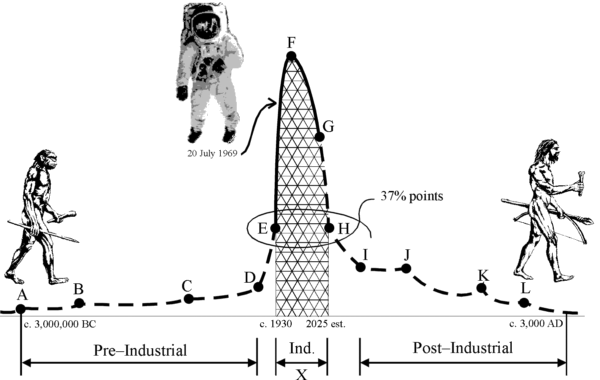
1. Pre-Industrial Phase [c. 3,000,000 BC to 1765]
A = Tool making begins (c. 3,000,000 BC)
B = Fire use begins (c. 1,000,000 BC)
C = Neolithic Agricultural Revolution (c. 8,000 BC)
D = Watt's steam engine, 1765
Interval D-E is a transition period.
2. Industrial Phase [1930 to 2025, estimated]
E = Industrial Civilization is defined to begin in 1930 when the leading-edge value of energy-use per person reached 37% of its peak value.
F = Peak of Industrial Civilization, c. 1978: confirmed by historic data published by BP, IEA, USCB, UN, etc.
G = World average energy-use per person continues to fall, 1996
H = Industrial Civilization is defined to end when energy-use per person shrinks to 37% of its peak value, forecast to occur by 2025. Life-expectancy (X) is estimated to be less than 100 years.
Interval H-I is a transition period.
3. Post-Industrial Phase [c. 2100 and beyond]
J, K, and L = Recurring future attempts at industrialization fail.
-------------------------------------------------------------------------------- http://www.hubbertpeak.com/duncan/OlduvaiTheorySocialContract.pdf
End Notes
1. Hydrocarbons, of course, are the crucial source of primary
energy for industrial civilization – as it now exists. However
if we had abundant and affordable electric power from other
sources, then civilization – in some form and at some
population level – could continue indefinitely sans
hydrocarbons.
2. “We have, in the above generalizations the law of cultural
evolution: Culture develops when the amount of energy
harnessed by man per capita per year is increased; or the
efficiency of the technological means of putting this energy to
work is increased; or, as both factors are simultaneously
increased†(White, 1943). But as far as I know no one has
ever quantified how world total energy efficiency has
changed over time.
3. Engineers usually represent electromagnetic energy as
waves. Physicists often represent it as particles. A coherent
theory is lacking.
4. The OT says that permanent blackouts will be the
instantaneous (direct) cause of collapse of industrial
civilization. In contrast, the deeper causality will be a
complex matrix of delayed feedback interactions, including:
depletion of nonrenewable resources, lack of capital and
operational investment funds, soil erosion, declining
industrial and agricultural production, Peak Oil, global
warming, pollution, deforestation, falling aquifers,
unemployment, resource wars, and pandemic diseases – to
name just a few.
5. For exponential growth the year-on-year incremental
changes must be positive and exponential; for exponential
decline they must be negative and exponential.
© 1996, 1997
INSTITUTE on ENERGY and MAN
Richard C. Duncan Ph.D., Director
updated 2006 February 7
updated 1997 December 18