
More on OKC Bombing - Another Clear Case of Fraud the Success of Which Paved the Way for 9/11

[edit] Timothy McVeigh
The United States was represented by a team of prosecutors, led by Joseph Hartzler. In his opening statement, Hartzler outlined McVeigh's motivations and the evidence against him. McVeigh's motivation, he said, was hatred of the government, which began during his tenure in the Army as he read The Turner Diaries, and grew through the increase in taxes and the passage of the Brady Bill, and grew further with the Waco and Ruby Ridge incidents. The prosecution called 137 witnesses, including Michael Fortier, Michael's wife Lori Fortier, and McVeigh's sister, Jennifer McVeigh, all of whom testified on McVeigh's hatred of the government and demonstrated desire to take militant action against it. Both Fortiers testified that McVeigh had told them of his plans to bomb the Alfred P. Murrah Federal building. Michael revealed how McVeigh had chosen the date and Lori testified that she created the false identification card that McVeigh used to rent the Ryder truck.[86][87]
In his trial, whose venue had been moved from Oklahoma City to Denver, Colorado, McVeigh was represented by a defense counsel team of six principal attorneys led by Stephen Jones.[88] According to Linder, McVeigh wanted Jones to present a "necessity defense"––which would argue that he was in "imminent danger" from the government (that his bombing was intended to prevent future crimes by the government, such as the Waco and Ruby Ridge incidents).[86] McVeigh argued that "'imminent' does not mean 'immediate.' If a comet is hurtling toward the earth, and it's out past the orbit of Pluto, it's not an immediate threat to Earth, but it is an imminent threat."[89] Contrary to his client's wishes, however:
Jones opted for a strategy of trying to poke what holes he could in the prosecution's case, thus raising a question of reasonable doubt. In addition, Jones believed that McVeigh was taking far more responsibility for the bombing than was justified and that McVeigh, although clearly guilty, was only a player in a large conspiracy.... In his book about the McVeigh case, Others Unknown: Timothy McVeigh and the Oklahoma City Bombing Conspiracy, Jones wrote: "It strains belief to suppose that this appalling crime was the work of two men—any two men...Could [this conspiracy] have been designed to protect and shelter everyone involved? Everyone, that is, except my client...[.]" Jones considered presenting McVeigh as "the designated patsy" in a cleverly designed plot, but his own client opposed the strategy and Judge Matsch, after a hearing, ruled the evidence concerning a larger conspiracy to be too insubstantial to be admissible.[86]
Jones tried to link the bombing to associates of Terry Nichols in the Philippines; to Osama bin Laden and other Arab terrorists; to a German descendant of a Nazi Party leader; to Ramzi Yousef, mastermind of the World Trade Center bombing; and to associates of a white separatist group in the Oklahoma compound Elohim City.[90] In addition to arguing that the bombing could not have been accomplished by two men alone but must have been perpetrated by a conspiracy of more people whom McVeigh was protecting, Jones also attempted to raise reasonable doubt by arguing that no one had seen McVeigh near the scene of the crime and that the investigation into the bombing had lasted merely two weeks.[86] During the trial, Linder observed further:
The defense presented 25 witnesses over just a one-week period. The most effective witness for the defense might have been Dr. Frederic Whitehurst, who provided a damning critique of the FBI's sloppy investigation of the bombing site and its handling of other key evidence. Unfortunately for McVeigh, while Whitehurst could show that FBI techniques made contamination of evidence possible, he could not point to any evidence (such as trace evidence of explosives on the shirt McVeigh wore on April 19) that he knew to be contaminated.[86]
Numerous damaging leaks emerged, which appeared to originate from conversations McVeigh had with his defense attorneys. These included a confession that was said to have been inadvertently included on a computer disk that was given to the press. McVeigh believed that it seriously compromised his chances of getting a fair trial.[91] A gag order was imposed during the trial that prohibited attorneys on either side from commenting to the press on the evidence, proceedings, and opinions regarding the trial proceedings. The defense was only allowed to enter into evidence 6 pages of a 517-page Justice Department report criticizing the FBI crime laboratory, and David Williams, one of the agency's explosives experts, for reaching unscientific and biased conclusions about the Oklahoma City bombing. The report claimed that Williams had worked backward in the investigation rather than basing his determinations on forensic evidence.[92]
The jury deliberated for twenty-three hours. On June 2, 1997, McVeigh was found guilty on eleven counts of murder and conspiracy.[93][94] Although the defense argued for a reduced sentence of life imprisonment, McVeigh was sentenced to death.[95] After President George W. Bush approved the execution (since McVeigh was a federal inmate, federal law dictates that the President must approve the execution) he was executed by lethal injection at a U.S. penitentiary in Terre Haute, Indiana, on June 11, 2001.[96][97] The execution was televised on closed-circuit television so that the relatives of the victims could witness his death.[98]
[edit] Terry Nichols
Terry Nichols stood trial twice. He was first tried by the federal government in 1997 and found guilty of conspiring to build a weapon of mass destruction and of eight counts of involuntary manslaughter of federal officers.[99] After he received the sentence on June 4, 1998 of life-without-parole, the State of Oklahoma in 2000 sought a death-penalty conviction on 161 counts of first-degree murder. On May 26, 2004 the jury found him guilty on all charges, but deadlocked on the issue of sentencing him to death. Presiding Judge Steven W. Taylor then determined the sentence of 161 consecutive life terms without the possibility of parole.[100] He is currently held in the ADX Florence Federal Prison.[101]
[edit] Michael Fortier
Though Michael Fortier was considered an accomplice and co-conspirator, he agreed to testify against McVeigh in exchange for a modest sentence and immunity for his wife.[102][87] He was sentenced on May 27, 1998 to twelve years in prison and fined $200,000 for failing to warn authorities about the attack.[100] As discussed by Jeralyn Merritt, who served on Timothy McVeigh's criminal defense team, on January 20, 2006, after serving eighty-five percent of his sentence, Fortier was released for good behavior into the Witness Protection Program and given a new identity.[103]
[edit] Others
No "John Doe #2" was ever identified, nothing conclusive was ever reported regarding the owner of the missing leg, and the government never openly investigated anyone else in conjunction with the bombing. Though the defense teams in both McVeigh's and Nichols trials tried to suggest that others were involved, Judge Steven W. Taylor, who presided over the Nichols trial, found no credible, relevant, or legally admissible evidence of anyone other than McVeigh and Nichols as having directly participated in the bombing.[86]
[edit] Aftermath
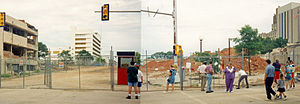

The site of the building after it was imploded, three months after the bombing
Until the September 11, 2001 attacks, the Oklahoma City bombing was the deadliest act of terror against the U.S. on American soil. Prior to this, the deadliest act of terror against the United States was the bombing of Pan Am Flight 103, which killed 189 Americans. In response, the U.S. Government enacted several pieces of legislation, notably the Antiterrorism and Effective Death Penalty Act of 1996.[104] In response to the trials of the conspirators being moved out-of-state, the Victim Allocution Clarification Act of 1997 was signed on March 20, 1997 by President Clinton to allow the victims of the bombing (and the victims of any other future acts of violence) the right to observe trials and to offer impact testimony in trials. In response to passing the legislation, Clinton stated that "when someone is a victim, he or she should be at the center of the criminal justice process, not on the outside looking in."[105]
In the weeks following the bombing, the federal government ordered that all federal buildings in all major cities be surrounded with prefabricated Jersey barriers to ward off similar attacks.[106] As part of a longer plan for United States federal building security, most of these temporary barriers have since been replaced with permanent security barriers which look more attractive and are driven deep into the ground for sturdiness.[107][108] Furthermore, all new federal buildings must now be constructed with truck-resistant barriers and with deep setbacks from surrounding streets to minimize their vulnerability to truck bombs.[109][110][111] FBI buildings, for instance, must be set back 100 feet from traffic.[112] The total cost of improving security in federal buildings across the country in response to the bombing reached over $600 million.[113] In June 1995, the General Services Administration issued Vulnerability Assessment of Federal Facilities, also known as The Marshals Report. These findings resulted in a thorough evaluation of security at all federal buildings and a system for classifying risks at over 1,300 federal facilities owned or leased by the federal government. Federal sites were divided into five security levels ranging from Level 1 (minimum security needs) to Level 5 (maximum).[114] The Alfred P. Murrah Building was a Level 4 building.[115] Among the 52 security improvement factors were parking, lighting, physical barriers, closed circuit television monitoring, site planning and access, vehicular circulation, standoff distance (which is the setback of the building envelope from the street to mitigate truck bomb damage), hardening of building exteriors to increase blast resistance, glazing systems to reduce flying glass shards and fatalities, and structural engineering design to prevent progressive collapse.[116]
According to Mark Potok, director of Intelligence Project at the Southern Poverty Law Center, law enforcement officials have foiled over fifty domestic terror plots since the Oklahoma City bombing.[2] The attacks were prevented due to measures established by the local and federal government to increase security of high-priority targets and following-up on hate groups within the United States.

The Field of Empty Chairs, east Gate of Time, and Reflecting Pool at the Oklahoma City National Memorial.
The attack led to improvements in engineering for the purpose of constructing buildings that would be better able to withstand tremendous forces. Oklahoma City's new federal building was constructed using those improvements. The National Geographic Channel documentary series Seconds From Disaster suggested that the Murrah Building would probably have survived the blast had it been built according to California earthquake design codes.
Even many who agreed with some of McVeigh's politics viewed his act as counterproductive. Much of the criticism focused on the deaths of innocent children. Bob Murphy of Anti-State argued that the attack would "lead ordinary Americans to trust the government when it says those who oppose it are crazy fanatics."[117] Liz Michael opined, "McVeigh was wrong. Not because he was a killer. Because killing is often necessary and sometimes good, even godly. McVeigh was wrong because he was a bad soldier. His target was wrong. His timing was wrong. And there was no clear moral grounding in his plan."[118] These critics, and others, expressed chagrin that McVeigh had not assassinated specific government leaders instead. Indeed, McVeigh had considered assassinating Attorney-General Janet Reno and others rather than bombing a building,[119] and after the bombing said that sometimes he wished he had committed a series of assassinations instead.[120] However, Outpost of Freedom decried the labeling of McVeigh as a "baby-killer," arguing that the blame for the children's death rested on the parents who brought them to a federal building and the government that maintained a day care center there despite Government Accounting Office recommendations;[121] sentiments echoed by McVeigh himself in An Essay on Hypocrisy.[122] It criticized the patriot media for taking a "politically correct position in expressing concern and declaring the event as an unnecessary tragedy."[123] Those who expressed sympathy for McVeigh typically described his deed as an act of war, as in the case of Gore Vidal's essay, The Meaning of Timothy McVeigh.[124][125] Other journalists compared him to John Brown.[126]
In response to Timothy McVeigh's description of himself as a libertarian, Libertarian Party national director Steve Dasbach said:[127]
| “ | "Timothy McVeigh is not just a mass murderer; he's a very confused mass murderer. Besides having no appreciation for the value of human life, McVeigh apparently has no understanding of the meaning of the word libertarian. Just to set the record straight, real libertarians wholeheartedly reject the use of force to achieve political or social goals. Real libertarians see violence and try to prevent it, see problems and organize cooperative solutions, and see government abusing its power and work peacefully through the political system to protect our rights. | †|
McVeigh thought that the bombing had a positive impact on government policy. As evidence, he cited the peaceful resolution of the Montana Freemen standoff in 1996, the government's $3.1 million settlement with Randy Weaver and his surviving children four months after the bombing, and April 2000 statements by Bill Clinton regretting his decision to storm the Branch Davidian compound. McVeigh noted, "Once you bloody the bully's nose, and he knows he's going to be punched again, he's not coming back around."[128]
[edit] Oklahoma City National Memorial & Museum
For two years after the bombing, the only memorial for the victims were stuffed animals, crucifixes, letters, and other personal items left by thousands of people at a security fence surrounding the site of the building.[129]
Although multiple ideas for memorials were sent to Oklahoma City within the first day after the bombing, an official memorial planning committee did not form until early 1996.[130] The Murrah Federal Building Memorial Task Force, composed of 350 members, was established to formulate plans in choosing a memorial to commemorate the victims of the bombing.[79] On July 1, 1997, the winning design was chosen unanimously by a 15-member panel from 624 submissions.[131][132] The memorial, which has become part of the National Park Service, was designed by Oklahoma City architects Hans and Torrey Butzer and Sven Berg. It was dedicated by President Clinton on April 19, 2000, exactly five years after the bombing.[132][133]

After surviving the bombing, The Survivor Tree elm became an emblem of the memorial.
The museum includes a reflecting pool flanked by two large "gates", one inscribed with the time 9:01, the opposite with 9:03, the pool between representing the moment of the blast. On the south end of the memorial is a field full of symbolic bronze and stone chairs—one for each person lost, arranged based on what floor they were on. The chairs represent the empty chairs at the dinner tables of the victim's family. The seats of the children killed are smaller than those of the adults lost. On the opposite side is the "survivor tree", part of the building's original landscaping that somehow survived the blast and fires that followed it. The memorial left part of the foundation of the building intact, so that visitors can see the scale of the destruction. Around the western edge of the memorial is a portion of the chain link fence which had amassed over 800,000 personal items which were later collected by the Oklahoma City Memorial Foundation.[134]

In front of the memorial is a statue of Jesus weeping for the victims who died in the bombing
On a corner adjacent to the memorial is a sculpture titled "And Jesus Wept", erected by St. Joseph's Catholic Church. St. Joseph's, one of the first brick and mortar churches in the city, was almost completely destroyed by the blast. The statue is not part of the memorial itself but is popular with visitors nonetheless. North of the memorial is the Journal Record Building which now houses the Oklahoma City National Memorial Museum, an affiliate of the National Park Service. Also in the building is the National Memorial Institute for the Prevention of Terrorism, a non-partisan think tank.

Flowers and personal items left on several of the 168 memorial chairs on the 10th anniversary of the bombing.
[edit] Remembrance
From April 17 to April 24, 2005, to mark the tenth anniversary of the bombing in Oklahoma City, the Oklahoma City National Memorial held a week-long series of events known as the "National Week of Hope."[135]
On April 19, as in previous years, the tenth anniversary of the bombing observances began with a service at 09:02 CST, marking the moment the bomb went off, with the traditional 168 seconds of silence - one second for each person who was killed as a result of the blast. The service also included the traditional reading of the names, read by children to symbolize the future of Oklahoma City.[136]
Vice President Dick Cheney, former president Clinton, Oklahoma Governor Brad Henry, former Oklahoma governor Frank Keating, and other political dignitaries attended the service and gave speeches in which they emphasized that "goodness overcame evil".[137] The relatives of the victims and the survivors of the blast also made note of it during the service at First United Methodist Church in Oklahoma City.[138]
President George W. Bush made note of the anniversary in a written statement, part of which echoes his remarks on the execution of Timothy McVeigh in 2001: "For the survivors of the crime and for the families of the dead the pain goes on."[139] Bush was invited but did not attend the service because he was en route to Springfield, Illinois to dedicate the Abraham Lincoln Presidential Library and Museum. Vice President Cheney presided over the service in his place.[137]
[edit] Conspiracy theories involving more perpetrators

Rescue Team 5 remembers the victims who died in the bombing.
Some people believe that a conspiracy is covering up the existence of additional explosives planted within the Murrah building.[140] Multiple websites show alleged cover-ups and other possible perpetrators who helped in planning the bombing.[141][142][143]
Conspiracy theorists say that there are several discrepancies, such as an inconsistency between the observed destruction and the bomb used by McVeigh. One vocal proponent of this view is Brigadier General Benton K. Partin.[144] Many critics of the official explanation point to a blast effects study published in 1997, utilizing test results from the Eglin Air Force Base, which concluded that "it is impossible to ascribe the damage that occurred on April, 1995 to a single truck bomb containing 4,800 lbs. of ANFO" so that the damage to the Murrah building was "not the result of the truck bomb itself, but rather due to other factors such as locally placed charges within the building itself".[145]Some experts ascribe the unusually large blast pattern to a thermobaric weapon, utilizing highly flammable metal particles mixed with a liquid high explosive. When ignited in a two-stage process, the device creates a super-high heat and pressure blast capable of flattening buildings.[146]
Several witnesses reported a second person seen around the time of the bombing; investigators would later call him "John Doe 2". There are several theories that the second person was also affiliated with the bombing and was even a possible foreign connection to McVeigh and Nichols.[147]This was due to the fact that Terry Nichols travelled through the Phillipines while terrorist mastermind Ramzi Yousef of the 1993 World Trade Center bombing was planning his Project Bojinka plot in Manila.[148] Although the U.S. government did arrest an Army private who resembled an artist's rendering of John Doe 2 based on eyewitness accounts, they later released him after their investigation reported he was not involved with the bombing.[149]
Some people have argued that seismic recordings of the event indicated multiple bombs. This contention was refuted by U.S. Geological Survey and Oklahoma Geological Survey scientists, who recorded and analyzed seismic signals from the demolition of the Murrah building. These demolition seismograms showed that the two pulses of energy recorded in Norman, OK from the bombing were due to the seismic response of the Earth rather than to multiple blast sources.[150]
In 2006, congressman Dana Rohrabacher said that the Subcommittee on Oversight and Investigations of the U.S. House Committee on International Relations, which he chaired, would investigate whether the Oklahoma City bombers had assistance from foreign sources.[151] On December 28, 2006, when asked about fueling conspiracy theories with his questions and criticism, Rohrabacher told CNN: "There's nothing wrong with adding to a conspiracy theory when there might be a conspiracy, in fact."[152]
SPLCenter.org: 'Risking Their Freedom'
... Freedom to Bring Truth to ... Benton Partin, an aging architect of key militia conspiracy theories like the idea that there were actually two or more Oklahoma City bombs, sounded a bit ...
- gretavo's blog
- Login to post comments
the fake OKC truth movement...
must be read to be believed... http://www.devvy.com/briley/OKC_Bombing_Revelations.pdf
notice any parallels?
The Globalization of Heartland Terror:
International Dimensions of the Oklahoma City Bombing
Mathieu Deflem
deflem@sc.edu
www.mathieudeflem.net
This paper was presented at the annual meeting of the Law & Society Association, Toronto, June 1995.
Cite as: Deflem, Mathieu. 1995. "The Globalization of Heartland Terror: International Dimensions of the Oklahoma City Bombing." Paper presented at the annual meeting of the Law & Society Association, Toronto, June 1995. Available online via www.mathieudeflem.net.
--------------------------------------------------------------------------------
.
This paper offers a discussion of selected aspects of the Oklahoma City bombing, specifically the immediate response following the bombing when suspicions were raised that the perpetrators were members of foreign terrorist organizations. This paper reviews the dynamics of these initial reactions. Additional notes are offered on the role of the media in the world of terrorism.
The Geography of Terror
On Wednesday, April 19, 1995, at 9.02 am, a bomb devastated the nine-stories Alfred P. Murrah federal building in Oklahoma City. The death-toll initially stood at 21, with hundreds of people missing. Late April, 110 people were confirmed dead, and on May 5 the search for bodies was halted with the death-toll at 164. After the building was demolished late May, three more corpses were found, bringing the total death-toll to 168, including a nurse who had died during the rescue operation, with over 500 people injured.
The most striking response following the bombing, even more conspicuous than the loud and angry cries to bring the perpetrators to justice, was the utter outrage that such a ferocious act had taken place in America, and not in one of its political and economic centers but in a Middle-American town. "We're just a little old cowtown," said Bill Finn, one of the fire-fighters involved in the rescue operation. "You can't get no more Middle America than Oklahoma City. You don't have terrorism in Middle America" (New York Times, hereafter NYT, April 20, 1995, pp. A1, A13).
The possibility of a terrorist attack striking America was unheard of in the minds of American citizens who are more accustomed, as one report claimed, to viewing major disasters in "places like Somalia, Rwanda, Chechnya and Bosnia." For most Americans, the report continued, terrorist-related disasters remain distant, black and white images, "like the grainy films of Nazi death camp corpses being bulldozed into mass graves. Long ago. Far away. Would never happen here" (Chicago Tribune, hereafter CT, 1995i).
One by one people across the country said the same thing, "this does not happen here." A rescue worker observed, "It happens in countries so far away, so different they might as well be on the dark side of the moon. It happens in New York. It happens in Europe" (NYT, April 20, 1995, p. A1). Newsreports reiterated the theme that terrorism "doesn't happen here. It looked like Beirut" (Newsweek, May 1, 1995, p. 26).
But the bombing did take place in the United States, in the very center of the country, "deep in America's heartland" (Newsweek, May 1, 1995, p. 26). "It's not Jerusalem, It's not Baghdad. It's not Bolivia. It's Oklahoma", a survivor declared (Ibid., p. 23). Headlines emphasized the shocking recognition: "Terror at Home" (Ibid., p. 3), "Home Grown Terror" (U.S. News, May 1, 1995, p. 1), "This Is America" (NYT 1995r).
The incidental location of Oklahoma City in the geographic mid-point of America inspired the most frequently used metaphor to describe the bombing, "Terror in the Heartland." Other media headlines likewise stated, "A Blow to the Heart" (Time, May 1, 1995, p. 36), "Terror Visits America's Heartland" (CT 1995b), "A Strike at the Very Heart of America" (U.S. News, May 1, 1995, p. 51). The choice of metaphor clearly expressed the theme that the terror of Oklahoma City was felt all over America, that the "Heartland city" had turned into "our town" (Lyfestyles, 1995, pp. 4-5).
That such a tragic event had taken place in America disrupted feelings of taken for granted safety and had to imply that terrorism could strike anybody, anywhere, any time. "It could happen anywhere," said the director of a child-care center. "It happens all over, and now it's hitting home... You think, it could happen any day. Anywhere," a parent complained (CT, April 21, 1995, p. 16). "If any statement was made," political scientist Douglas Simon said, "it's that any place can be targeted" (NYT 1995j). And a journalist remarked, "Yes, there is no place in this country, let alone in the ever-shrinking world, that is absolutely safe from violence" (CT 1995j). William Studeman, acting head of the CIA, confirmed that the Oklahoma bombing indicated "the true globalization of the terrorist threat" (CT 1995d).
Amplifying the unsettling emotions of terrorism hitting home was the chilling fact that the bombing had children among its casualties. Hours after the bombing, when hundreds of people were still reported missing, 17 of the 21 people confirmed dead were children from the building's day-care center. The father of a surviving child remarked, "I've seen soldiers...cut in half, heads cut off. That was war. These are children. This is not a war. This is a crime" (Time, May 1, 1995, p. 62).
The fact that children had died in the bombing heightened the sense of vulnerability and awareness of the horror, but the children also served to share grief and unite against the terrorist act. The day after the bombing, President and Mrs. Clinton held their weekly radio address before 26 children in the Oval Office. They urged the children to express their fears about the blast. Through Oklahoma City, all of America was struck, and through the children, all Americans were hurt.
A World of Suspects
The recognition that terror had hit America was so devastating that to bridge the severe clash between expectation and reality, the guilty were readily presumed to come from abroad. Terrorism in America did not make sense if it had not originated from outside America's borders. Following the first reports of the bombing, various sources hinted at the involvement of international terrorists. Several news organizations reported that investigators were looking for several Middle-Eastern men who had driven away from the building shortly before the blast (NYT 1995a). Soon after TV cameras had arrived at the scene, former Oklahoma Congressman Dave McCurdy was talking to CBS reporters about "very clear evidence" of the involvement of "fundamentalist Islamic terrorist groups" (NYT, April 20, 1995, p. A12). McCurdy reminded viewers that not long ago a PBS documentary, Jihad in America, had reported on Islamic militants meeting in Oklahoma City. Few hours later on CNN, Senator James M. Inhofe, a Republican who cursorily noted that he had beaten Mr. McCurdy for the Senate seat last year, called Mr. McCurdy's remarks a disservice. Then came a CNN report of suspects of Middle-Eastern appearance being pursued. Then came a CNN denial. But then came a CNN report that two or three such men were being sought. Then it was reported that three Arab men had been arrested (NYT, April 20, 1995, p. A12; Newsweek 1995a). Later in the evening, on the TV show Larry King Live, McCurdy repeated that an Islamic conference full of "fire-breathing rhetoric" was held in Oklahoma City in 1992. That was one reason he said he knew terrorism "could happen here" (Time, May 1, 1995, p. 70).
The first list of suspects was long, including possibly anybody but surely foreign suspects. An early newsreport announced that "Middle Eastern groups have held meetings in Oklahoma City, and the city has a number of Arab-American residents" but also added that "far larger Arab-American populations exist in other cities like Detroit, Chicago and Los Angeles" (NYT 1995a). Even McCurdy did not rule out domestic terrorists. "It could be a right-wing, anti-government militant group", he said (CT 1995a).
In the absence of a claim of responsibility for the bombing, the first days were full of speculations. The date of the bombing, April 19, was linked to the Branch Davidian tragedy in Waco, Texas, which had taken place two years earlier to the day. The accusation was denied by surviving Davidians. Vague connections to tensions in the Middle East, retribution for American interventions, and lingering Persian Gulf war bitterness were added to the list. The Nation of Islam was quick to deny unverified rumors (CT, April 20, 1995, p. 18). Another report called the connection with the anniversary of the Branch Davidian assault a "more far-reaching" theory than the fact that American planes had "bombed Libya nine years ago this month" (CT 1995a).
During his first public address on the bombing, President Clinton stated that the terrorist act was an "attack on the United States, our way of life and everything we believe in" (Lyfestyles, 1995, p. 15). This expressed and confirmed the anti-American character of the bombing and it at least implicitly insinuated that guilt lay outside America's borders. Clinton added that searching and convicting the perpetrators was "not a question of anybody's country of origin,... not a question of anybody's religion" (Lyfestyles, 1995, p. 15). The disclaimer, of course, only made sense in view of a suspicion towards Middle-Eastern Muslims.
The many suggestions that international terrorists were involved had some remarkable implications. In the press, speculations of foreign involvement on occasion turned into straightforward accusations. "Ending forgiveness," a commentary headlined, stating that "although the West will not deliberately bomb civilians, it will attack terrorists and their encampments wherever found" (NYT 1995d). One of the harshest responses came from Mike Royko, a writer for the Chicago Tribune, known well for his invariably insensitive and racist editorials. He not only accused foreigners for the bombing, but also proposed that U.S. authorities should immediately retaliate by bombarding "a country that is a likely suspect." If it happens to be the wrong country, he added, "well, too bad, but it's likely it did something to deserve it anyway" (CT 1995c). The statement sustained the view that terrorism divides nations, good and evil, splits the world apart between savagery and civilization. Nations that "help terrorism with weapons and money, or paint other people as Satans whose murder is a gift to God" were put opposite from and at war with the "target nations" (NYT, April 25, 1995, p. A15).
The day after the bombing, defense lawyers in the terrorism trial of Sheik Omar Abdel Rahman and 10 other men in New York took advantage of the presumed foreign element in the Oklahoma City bombing. The lawyers made requests for a mistrial and for jury sequestration because their clients' right to a fair trial would be imperiled by news reports about the Oklahoma City bombing. The judge denied the requests but instructed jurors to avoid news accounts of the Oklahoma City bombing, emphasizing that the Oklahoma attack "is not part of this case" (NYT 1995c).
The early accusations of Arab-American suspects prompted Islamic leaders across the U.S., who obviously feared a backlash against Muslims, to immediately condemn the bombing and offer assistance in bringing the perpetrators to justice. The Arab-American Anti-Discrimination Committee condemned the bombing as "a cowardly act" and warned against premature speculation about the identity of those behind it (CT 1995a). The Council of Islamic Organizations of Greater Chicago issued a statement denouncing the bombing and noting "the tragic state of affairs that Muslims feel special pressure to express this condemnation" (NYT 1995b). Muslim organizations abroad, such as the Hezbollah and the Lebanese Shiite party in Lebanon, also condemned the act (NYT 1995e). And Arab-American organizations stressed that radical Jews are as much tied to the United States as are radical Muslims and that certain Islamic fundamentalists had received training from the CIA during the fight against the Russian occupation of Afghanistan (NYT 1995i).
The urgency Arab-Americans felt to condemn the bombing betrayed how much they too were pondering the possibility of foreign involvement or at least fully realized the presumptions others would make. Moreover, the fact that Muslim organizations denounced the act of terror, raised money for the victims, offered blood and provided care to survivors, did not halt abuse against Muslim Americans. Several mosques across the country received telephone threats. "We have your address and we are going to do what you did, killing our children", a caller said on a message recorded at a mosque in Richardson, Texas (CT 1995e). Sparked by anti-Muslim messages on some of Oklahoma City's talk radio shows, several Arab-American citizens were harassed. A few hours after the bombing, Imad Enchasi, a restaurant manager, offered to shake a friend's hand but heard him proclaim, "Your people had better not have done this" (CT 1995e). Several children of Arab descent were reported to have been abused by classmates urging them to "go back to where you came from" (NYT 1995h). In Chicago, the windshield of a car belonging to a Palestinian person was smashed while the local Mosque Foundation held a blood drive and a fundraiser for the Oklahoma bombing victims (CT 1995g).
Suhair Al Mosawi is a 26-year-old Shiite Muslim and refugee from Iraq (NYT 1995h). The day of the bombing, someone threw a rock through a window of her home in Oklahoma City. Frightened by the event, Mrs. Al Mosawi, who was 7 months pregnant, felt terrible pains in her abdomen, began bleeding uncontrollably, and few hours later gave birth to a stillborn boy. "His name will not be listed among the victims of the bombing," a newsreport stated (CT, April 25, 1995, p. 20).
Racism and the prevailing conception of terrorism as a foreign phenomenon do not fully explain what is involved here. A more basic phenomenon is revealed: the human inclination to attribute all that is evil to forces far away, beyond one's familiar surroundings. As a journalist expressed, "From what universe beyond the one that most of us inhabit does this kind of evil arise?... For what reason [were children killed]? Because there are wackos roaming the earth?" (NYT, April 22, 1995, op-ed page). The initial solution, to blame foreigners in general and Muslim fundamentalist in particular, made sense in view of Americans' general ignorance on international affairs, our collective conscience about terrorism, and long-standing xenophobic strains in American culture related to slavery, anti-Semitism, segregation and enduring racial antagonisms. But, more fundamentally, it also revealed, as one commentator aptly remarked, "how important it is for us to place the blame somehow outside what we conceive of as 'our' culture, and in so doing to declare the soundness of that culture" (CT 1995j). Moreover, although the realization that terrorism could and had hit America was difficult to acknowledge, at least the goals of international terrorism seemed familiar, and the proper American response seemed clear, namely putting pressure against foreign governments that sponsor terrorists and striving towards more and better surveillance of known and suspected terrorist groups (NYT, April 24, 1995, p. A16). The anger against foreign terrorists, moreover, could have been channeled against a fixed enemy, "uniting the country as only an external enemy can do" (Newsweek 1995a, p. 55). But the suspects were "actually fellow Americans" (CT 1995j).
The Enemy Within
On April 20, one day after the bombing, the FBI issued warrants for the arrest of two suspects described as white males. The "sickening evidence" indicated that the enemy was not some foreign power "but one within ourselves" (NYT, April 23, 1995, p. E1). The horror was "homegrown" (Newsweek, May 1, 1995, p. 28).
Terrorism, at first tightly intertwined with an evil taking place only abroad and then at least originating from afar, was now differentiated and qualified. The distinction between international and domestic terrorism was introduced. But the switch was not easily made. After all, explosives similar to the ones that were reported to have destroyed the federal building in Oklahoma had been used in a terrorist attack on the U.S. embassy in Beirut in 1983, and a Ryder truck like the one that was reported to have driven its deadly load to Oklahoma City had also been used in the World Trade Center bombing (U.S. News 1995b, pp. 37-38). On the day authorities released news of the white-male suspects, one could still read that the two white males did not "appear" to be foreigners (NYT, April 21, 1995, p. A9).
With the warrants for white-males made public, Muslim organizations in the U.S. and across the globe were seeking for apologies for the early finger-pointing. Some newsreports did offer apologies to the foreign-born Americans who had been harassed and abused (CT 1995h; Newsweek 1995a), but others reminded that few days before the Oklahoma City bombing, Ramzi Ahmad Yousef, the alleged mastermind of the New York Trade Center explosion, issued a statement from jail claiming that because the United States supports Israel, it is a partner in all the crimes committed against Palestine and Palestinians. Because taxes from American citizens are used to support Israel, the statement asserted, it is "logical and legal" to hold the American people responsible for all these crimes and Palestinians "have a right to hit at American targets" (CT, April 23, 1995, sec. 4, p. 3). Five days after the bombing, an editorial discussed the domestic nature of the bombing and the early suspicions of foreign involvement but still remained cautious: "investigators have increasingly come to believe that this was a domestic act of terrorism against the Government... The early theory that the bombing might be the work of terrorists from abroad...is fading. That should give pause to all those who jumped to air-trigger accusations. Now the nation will be forced to look more closely at what is happening within its own borders, where the evil is more difficult to acknowledge... The presumed perpetrators in Oklahoma are not, it seems, foreign terrorists" (NYT, April 24, 1995, p. A16).
Before the suspects were caught, Weldon Kennedy, the FBI agent in charge at the bombing site, did not rule out possible connections to Muslim fundamentalists. Asked at a news conference if the description of the suspects as 'white males' precluded them from being of Middle-Eastern origin, he replied, "Certainly not" (NYT, April 21, 1995, p. A10). The suspects, it was reported, did not have accents and did not have appearances that suggested Middle-Eastern origins, so that the early speculations that the bombers might be Middle-Eastern were "apparently squashed, at least for now" (NYT, April 21, 1995, p. A10). Two days after the bombing, Attorney General Reno stated for the first time that the terror "seemed to be a domestic case." Other officials said they remained "open to all possible motives, including international terrorist links" (NYT, April 22, 1995, p. 10). But, still, the warrants for the suspects went not by Arab names but were described as John Doe #1 and John Doe #2, like in the Frank Capra movie title, "resonant of everything American" (Newsweek 1995a, p. 55).
The initial shock that terrorism could hit home was doubled when the first person arrested in connection with the horrendous crime was "not a swarthy foreigner who plotted his villainy in a nerve center in Tripoli, Libya, or Brooklyn, N.Y., but a crew-cut native son with good cheekbones and a firm jaw whom we ourselves had trusted and trained to defend our country" (CT 1995j). Robert Coles, a Harvard University psychiatrist and social historian, said, "We know this country can handle external enemies, but for one of our own to strike a blow against the Federal Government, against our own family, is very unnerving, very frightening" (NYT, April 23, 1995, p. E1).
The search for the enemy within had detailed investigations mixed with pure luck (NYT, April 22, 1995, pp. 1, 8; Newsweek 1995b). At the bombing site, an FBI agent found a piece of metal with a VIN (Vehicle Identification Number) belonging to a rented truck. Also available was a videotape from a bank's automatic teller machine with the image of a Ryder truck. Using a national computerized information system, the VIN informed investigators that the truck came from Elliott's Body Shop in Junction City, Kansas. The truck had been registered under false names, but witnesses were able to provide the images of John Does #1 and #2. At the Dreamland Motel in Junction City, a woman recognized in one of the sketches a former guest who had registered under the name Tim McVeigh. In the meantime, less than two hours after the bombing, McVeigh had been arrested by Oklahoma Highway Patrolman Charlie Hanger for driving without a license plate and concealed-weapons charges. McVeigh's car had a sticker on the bumper that read "American and Proud" (NYT, April 22, 1995, p. 10).
Timothy J. McVeigh, alias John Doe #1, was brought to the Noble County jail in Perry, Oklahoma. A telephone tip from a former co-worker confirmed McVeigh's name and identity. Through a national computer search, federal authorities discovered the arrest of McVeigh, who was handed over to the FBI and charged with malicious damage and destruction of a federal building. He faces the death penalty.
McVeigh's license bore the address of a farm in Decker, Michigan, owned by the brothers James and Terry Nichols. Terry Nichols surrendered to police in Herington, Kansas, and James Nichols was detained. The three men were linked to the Michigan Militia, an anti-government paramilitary group, and described as sympathizers of the Branch Davidian cult. The Oklahoma City federal building housed offices of the Bureau of Alcohol, Tobacco and Firearms which took part in the Waco raid exactly two years before the Oklahoma bombing.
On April 25, a new sketch of John Doe #2 was released, but investigators came to believe the sketch could be based on erroneous witness accounts or refer to Joshua Nichols, Terry Nichols' 12-year old son. Later, a third sketch was released and investigators claimed the hunt for John Doe #2 was still on. By mid-June, several former Army enlisted men, look-alikes and drifters had been investigated by police officials, but John Doe #2 was not found. Terry Nichols was charged for aiding and abetting the bombing. His brother James has been released although he faces unrelated explosives charges. Beyond the two arrests, investigations on the bombing remain unclear as to the perpetrators' intent and planning (NYT 1995u).
The suspects police caught were not foreign or foreign-born. "They're from America", a resident from Decker said. "What had seemed so far removed from us has indeed shown up in our backyard", a local priest echoed (CT, April 24, 1995, p. 1). Following the news that the Oklahoma terror had its roots in America, citizens struggled to comprehend that the bombers could be some of their own.
By the time Americans had been arrested, earlier reports on foreign involvement had to be retracted. But journalist Mike Royko, who had earlier suggested bombing a foreign nation, on May 10 still responded inconsiderately, "I apologize for having been the only person in America with the far-fetched notion that Middle Eastern terrorists could have been involved. Next time, I'll know better. If it isn't the Norwegians, it is surely the Swiss" (CT, May 10, 1995, p. 3). Misplaced cynicism aside, little has been said about the fact that the arrested suspects are white. That should not come as a surprise were it not for the fact that, as one commentator rightly feared, the color of the perpetrators could have mattered had they not been white, testified by the sense of relief among African-Americans that "at least the culprits were not black" (NYT 1995m).
A Global Dragnet
Police actions with a distinctly international character had taken place before and during the time the search turned to the John Doe suspects. "There is no place to hide. Nobody can hide anyplace in this country, nobody can hide anyplace in this world", President Clinton had warned during his first public address on the bombing (Lyfestyles, 1995, p. 15). After the President was informed of the bombing, he asked advisors if the airport at Oklahoma City could be closed to keep the bombers from fleeing abroad. But Leon Panetta, Clinton's chief of staff, advised against the idea because it would pose civil-liberties issues (Time, May 1, 1995, p. 65). On the day of the bombing, Israel's President Yitzhak Rabin called to offer his country's "antiterror expertise." But the President's advisors warned that enlisting Israel "might look anti-Arab" (Newsweek 1995b, p. 30). When Attorney General Janet Reno was asked at a press conference whether authorities were accepting help from the Israel government "because it has a vast experience with this sort of thing," she replied, "We will, of course, rely on any additional resource that can possibly be involved and be utilized appropriately in bringing these people to justice" (NYT, April 20, 1995, p. A14).
Early newsreports that an international police search was being conducted did not specify much of the actual operations. It was said that "U.S. authorities launched a worldwide search for suspects," that "Federal authorities consulted with other governments in a search for any foreign terrorists who might be involved in the bombing", that "International police agencies were enlisted in the search" (CT, April 21, 1995, p. 1), and that the "authorities scrambled round the world all last night and all of today for solid tips" (NYT, April 21, 1995, p. A12).
The day of the bombing, authorities discounted news accounts alleging that the FBI was searching for three suspects described as Middle-Eastern in appearance. But it was also reported that officials focused on the possibility that the attack had been the work of Islamic militants (NYT 1995a) and that some officials were focusing on Iranian student groups in Oklahoma (CT, April 20, 1995, p. 16). In the hours after the bombing, Secretary of State Warren Christopher told reporters that he had sent Arabic interpreters to aid the police investigations (NYT 1995h).
The next day, when warrants for the white-male suspects were already released, vague reports were still discussing that three "Middle Eastern-looking men" had been arrested in Oklahoma and Texas (CT, April 21, 1995, p. 14). Although the FBI denied any arrest, rumors persisted that three Middle-Eastern men had been picked up Wednesday night and held on immigration charges after they stopped to ask directions of an Oklahoma state trooper. The trooper supposedly checked out the car's license plates and found they should have been on a rental car, which was found at a motel in Oklahoma City (CT, April 21, 1995, p. 14).
The case of a fourth Middle-Eastern man was less covered in veil. The history of his case clearly evinces the international character of the police actions following the bombing and the effectiveness of "the dragnet that spread throughout the world after the bombing" (NYT, April 21, 1995, p. A12; see NYT, April 21, 1995, pp. A10, A12; CT, April 21, 1995, p. 14).
In the evening of Wednesday, April 19, a man was singled out for attention by Customs officials at O'Hare International Airport, Chicago. His appearance matched a profile of possible suspects, which included "young men traveling alone to destinations like the Middle East," issued by the FBI to "police agencies and airport authorities throughout the world" (NYT, April 21, 1995, p. A12). The man, it was reported, was "dressed in a jogging suit familiar to one that a witness in Oklahoma City reported seeing worn by a man at the scene of the explosion" (NYT, April 21, 1995, p. A12). Customs officials said the man, a young Arab-American whose name was not released, had checked onto a Chicago-bound American Airlines flight Wednesday in Oklahoma City. The plane was to continue from Chicago to Rome and eventually to Amman, Jordan, aboard an Alitalia jetliner. Federal officials said he was "looked at" by Customs agents and FBI and immigration officials before departing (NYT, April 21, 1995, p. A10). Questioning led the agents to discount the possibility of the man's involvement. But customs officials in Chicago talked to the man so long that he missed his flight to Rome. He changed to a flight to London, but his luggage was aboard the plane to Italy.
The luggage arrived at Leonardo da Vinci Airport, Rome. The Italian news agency AANS confirmed the bags were checked in at Oklahoma City, with final destination to Aman, Jordan. Three bags were seized by Italian authorities at the request of, or, as some reports stated, in direct collaboration with, American investigators (NYT, April 21, 1995, p. A10). The bags were found to contain "what the authorities called non-explosive materials, including needle-nosed pliers and silicon, that could be used to make explosives,... three gym suits, evidently similar to those said by witnesses to have been warned by person seen near the site of the bombing" (NYT, April 21, 1995, p. A10), in addition to "kitchen knives, aluminum foil, spools of electric wire,... photographic materials, a video recorder and a photograph album with pictures of military weapons, including missiles and armored vehicles" (NYT, April 21, 1995, p. A12) as well as "electrical tape" (CT, April 21, 1995, p. 14).
At London's Heathrow Airport, early Thursday morning, the man, described as a Jordanian-American who lives in Oklahoma, was detained by British immigration authorities. Law-enforcement authorities in Washington said they wanted to interview the man (NYT, April 21, 1995, p. A10). The British Home Office announced that a man was returning to the U.S. after landing at Heathrow Airport Thursday morning on a flight from Chicago. He was returned by plane under armed escort to the United States. Televised news accounts portrayed the British detention of the man as a major break in the case. Chief of staff Panetta received a Reuters dispatch about the detention and return back to the United States of the Jordanian-American passenger.
A hint that Britain was involved in the search for the bombing perpetrators had come earlier from Prime Minister John Major who said he had been in touch with President Clinton to offer condolences. Major added, "I have told him that we are ready to help in any way we can, and, as events will show, we are assisting." Mr. Clinton thanked Major for British help in the swift detention of the man. Attorney General Reno confirmed that the man was being accompanied back to the U.S. and was viewed as a "possible witness". After arriving at Dulles International Airport Thursday night, the man was held for further questioning by the FBI in Washington.
On April 22, a brief article in The New York Times reported that the man was released (NYT 1995f). The detainee was identified as Ibrahim Abdullah Hassan Ahmad, a volunteer teacher of Arabic at an Oklahoma mosque and a naturalized American of Palestinian descent. Mr. Ahmad said he had been mistreated by British authorities and that people had dumped trash on his lawn and spit on his wife (NYT 1995h). It was also confirmed that three other men had been questioned and were now released. In Dallas, Texas, Anis Siddiqy and Mohammed Chafi were released on Thursday, April 20, after Mr. Siddiqy had been questioned for 16 hours by FBI and ATF agents and the apartment of Chafi, where Siddiqy stayed, had been searched. Siddiqy's brother Asad R. Siddiqy was released in Oklahoma City. In the meantime, the international manhunt had made way for a localization of the enemy within.
Nations United In Terror
The recognition that terrorism could hit America was not easily made. But the bombing had occurred and comparisons with incidents of terrorism in other countries were made because the pictures of the shattered building in Oklahoma "evoked images of Beirut" (NYT, April 23, 1995, p. E1). The Oklahoma City explosion demonstrated that "the terrorism that has become part of life in Ulster and Jerusalem and a collection of other Middle Eastern and European datelines most commonly noted for long-running tragedy can visit the United States too" (CT, April 20, 1995, p. 18). "Beirut, Okla.," one headline summarized (NYT 1995g). "Throughout Europe and the Middle East," it was argued, "fear of terrorism long ago invaded the daily routine" (CT 1995d). President Clinton, incidentally, first heard of the bombing when talking to Turkish Prime Minister Tansu Ciller, who explained that Turkish attacks on Kurdish rebels in northern Iraq were a retaliation against terrorism (Time, May 1, 1995, p. 65).
Newsreports overseas almost triumphantly proclaimed America's loss of innocence. The U.S. now must recognize it is "no longer impervious" to terrorism, the French paper Le Monde asserted. The U.S. can no longer "reprimand small countries" for terrorism, a Cairo newspaper said. And newspapers in England and Germany warned against American responses to beef up the FBI and a return to McCarthyism (NYT 1995o).
In turn, American reports repeatedly stated that the United States could and should learn from foreign nations' experiences. "Even a top-security democracy like Israel cannot halt the suicide bomber," one reporter commented. And while "Americans have become blase about airport metal detectors," perhaps they should "get used to police with flak jackets and armored water cannons standing guard outside public buildings." That, after all, has already become "a regular part of the sometimes-grim urban landscape in Britain, Germany, Greece and Spain" (CT, April 21, 1995, p. 18). Americans by now are getting used to metal detectors in airports, but, a reporter remarked, such measures are "tame" compared to those that people have learned to accept "in countries where terrorism is a fact of life." In Israel, for instance, citizens accept them "as protective rather than invasive" (NYT, April 23, 1995, p. E1).
The renowned American philosopher Richard Rorty concurred that "Britain has been coping with terrorist bombs for generations without much retrenchment of civil liberties. If they can do it, we can too" (Time 1995a, p. 71). A columnist confirmed that "other democracies - Britain, France, Germany and Israel - have found it possible to strike a balance between safety and fairness. So can we" (NYT, April 22, 1995, op-ed page). Can we? In the wake of escalating IRA violence, Britain in 1974 introduced the Prevention of Terrorism Act which gave police broad search powers and the possibility to detain suspects for 7 days without charge (Time 1995a, p. 71-72). It remains to be seen whether such measures could pass the test of constitutionality in the United States.
Immediately transcending the comparisons with other nations was the distinctly Anti-American character attributed to the attack. The bombing was "a continuation of war by handier means", a manifestation of "spasms of anti-American warfare that defy the understanding of rational people" (CT, April 21, 1995, p. 18). This interpretation concurred with President Clinton's description of the bombing as an attack against America. And because of the anti-American nature of the bombing, America herself should respond in a distinctly American way. Most clearly, patriotic pride in the aftermath of the bombing was revealed in the rescue operation, with fire-fighters, law-enforcement officials, Red Cross volunteers, engineers and medical experts coming to the rescue from all across America. The "Heroes of the Heartland" brought out in exemplary manner "The Soul and Character of America" (Lyfestyles 1995; U.S. News, May 8, 1995, p. 10). No doubt the rescue operation mobilized many Americans in a united effort to heal the injured nation. Dr. Clyde Collins Snow, a forensic expert working at the bombing site, had previously identified victims of government massacres in Argentine, Chile and Kurdistan. He was one of the experts who identified the skull of Nazi doctor Joseph Mengele in Brazil, and he had recently participated in an unsuccessful attempt in Bolivia to trace the remains of Butch Cassidy and the Sundance Kid (NYT 1995e).
The New World Order
A distinctly international component is also revealed with respect to a distinctly intra-American phenomenon related to the bombing. It concerns aspects of the strategies and philosophies of the militia movements the suspects of the bombing have been linked to. While the precise connection between the charged suspects and the militia movements is unclear, the issue is worthy of discussion in the Oklahoma case if only because public discourse in press and politics has established the link and drawn this peculiar phenomenon to the center of debate.
The militia movements encompass a variety of groups, including the Aryan Nation, the Ku Klux Klan, the Holocaust-denying Liberty Lobby, survivalists, tax protesters and right-wing radicals defending family values, Christian beliefs, property rights and the right to bear arms. A first cross-border theme is revealed by the fact that they use the electronic internet to spread their ideas and tactics. On the internet, a newsreport stated, "extremists spread hate with every keystroke" (CT 1995f). 'Cyberhate,' for instance, is an electronic site transmitting the messages of a white-supremacist group (NYT 1995s). 'A Movement in Arms' is the name of an internationally disseminated computer program with information on building bombs and waging war against democratic governments (NYT 1995k). Other on-line messages generally contain anti-government rhetoric and have specifically contemplated whether the Oklahoma City bombing was the work of the U.S. government. These postings were listed under a category called "Oklahoma Reichstag," a reference to the 1933 burning of the German Parliament for which Adolf Hitler falsely blamed communists. Callers and hosts on the World Wide Christian Radio, a Nashville-based radio station, confirmed that the federal building in Oklahoma was destroyed by U.S. authorities "on behalf of a secret international cabal, the New World Order" (NYT 1995q). Certain militias confirmed this theory, asserting that the person accused for the bombing, Timothy McVeigh, is thought to be a federal agent, just like Lee Harvey Oswald (NYT 1995t).
On May 11, the Judiciary Subcommittee on Terrorism, Technology and Government Information held a debate on the use of the internet by groups advocating terrorist activities. It discussed ways to curb violence-inciting speech on the internet and reported that a week after the Oklahoma bombing an on-line message read, "I want to make bombs and kill evil Zionist people in the government. Teach me" (NYT 1995s). The Simon Wiesenthal Center tracked down 50 hate groups on the internet over the past year (U.S. News 1995b, pp. 37-44).
But right-wing militias do not only cross physical borders through high-tech communications within the United States, they also organize on a global scale. In The New York Times, Ingo Hasselbach, a self-professed former neo-Nazi from the former East-Germany, confessed to having been in contact with "a flourishing international network of neo-Nazis and racist movements" (NYT 1995k). He claimed the groups united in their hatred towards government authority, Jews and the multicultural society. Most of their instruction materials, the former neo-Nazi conceded, came from extremist groups in Nebraska and California where, unlike in Germany, the printing of such material is constitutionally protected.
Another cross-border theme of the militia movements concerns their philosophies (NYT 1995p, 1995q, 1995t; U.S. News, May 8, pp. 37-44). Next to a general resentment against federal government, blamed for the 1993 Waco tragedy, the 1992 shooting of the wife and son of white-separatist Randall Weaver in Idaho, and the 1993 Brady Law, militia groups also count among their targets non-white ethnic groups, specifically blacks and Asians, referred to as "mud" people, and Jews, described as the "children of Satan." Evoking the ominous prospect of one-world government and millennium doom, their enemies further include the so-called Zionist Occupation Government (ZOG), the United Nations, the Russians, the Trilateral Commission, the Council on Foreign Relations, Interpol and the Red Cross. The United Nations is seen as a force designed to take control of the United States in order to create a one-world government. Foreign U.N. troops, it is claimed, are training in America, using Los Angeles gangs to serve global government. To undermine America's sovereignty, Jews control international banking and have taken over the currency as demonstrated by the all-seeing Freemasons' eye and the slogan Novus Ordo Seculorum (wrongly translated as 'New World Order') on the back of the one-dollar bill. Black helicopters are spying on Americans, while road signs contain secret codes to direct foreign invaders. The zebra-stripped Universal Product Code will eventually be tattooed on everybody by laser to ease surveillance by the big panoptic eye. One of the early suspects of the bombing, James Nichols, renounced all formal identifications and in a letter to the Sanilac County clerk he characteristically called himself "a nonresident alien, non-foreigner, stranger."
The label with which all evil originating abroad is described is "The New World Order." Apparently, the usage of the term can be traced to the secret society, Yale's Skull and Bones social club. President George Bush, a Skull and Bones member, first used the term in 1990 when he was rallying the world against President Saddam Hussein of Iraq. A month later President Bush used the term again, now calling on the United Nations to ban certain chemical weapons. For many members of the militia movements, that was proof of an evil world-wide plot against the United States (NYT 1995p). The New World Order also featured as a favored target in Pat Robertson's book of the same title, noting that "a single thread runs from the White House to the State Department to the Council on Foreign Relations to the Trilateral Commission" (NYT 1995l). Although much has been said about President Clinton's rush to condemn right-wing radio hosts as "promoters of paranoia," it can be noted that Mark Koernke, leader of the Militia at Large and a short-wave broadcasting favorite of the militias, regularly signs off with the decree "Death to the new world order!" (NYT 1995l).
The Laws of Terrorism
Asked about the proper legislative response to the Oklahoma City bombing, famed sociologist Amitai Etzioni stated it would be "disingenuous and ignorant to argue that if we introduce a few carefully crafted limitations on what individuals may do, we will slide down a slippery slope into a police state" (Time 1995a, p. 71). Etzioni did not provide details on this careful crafting, but declared communitarian aspirations should certainly involve public debate on the matter. For better or for worse, the reawakened Omnibus Counterterrorism Act has meanwhile provided the most discussed forum for the legislative and police responses needed to thwart terrorism.
The Counterterrorism Bill was originally introduced by Representative Charles Schumer (D-N.Y.) in 1993 in response to the World Trade Center incident. It provides for anti-terrorism measures that allow government to use evidence from secret sources in deportation proceedings for aliens suspected of terrorist involvement. Under the measure, authorities would not have to disclose the source of the information and if classified information would be used to charge an alien with terrorist involvement, the person would only get access to a summary of the government's case (NYT, April 21, 1995, p. A12). The Bill would also include new sanctions for legal migrants who overstay their visas and less liberal terms for granting political asylum to foreign refugees (CT, April 21, 1995, p. 12).
The Counterterrorism Bill increasingly received support because concerns with terrorist threats, domestic as well as foreign, have loomed large after the Oklahoma City bombing. The universality of terrorism, in the sense of the sameness attributed to terrorists with respect to motivations and actions, provided the key justification in this respect. For as Gregory Cooper, acting chief of the FBI's Investigative Support Unit in Quantico, Virginia, remarked about terrorist activity, "Whether it's domestic or international, you're talking about the same kind of mind-set" (CT, April 21, 1995, p. 14). Likewise indicating the generic nature of terrorism, a journalist commented that the decisive law-enforcement response against the "terrorism threat, domestic and foreign," should come from "penetrating suspect organizations with spies recruited at home and abroad" (NYT, April 22, 1995, op-ed page). President Clinton urged Congress to pass the Bill along with promises of 1,000 new law-enforcement personnel and broader FBI police powers, including access to phone bills, credit reports and transportation records of suspected plotters (NYT, April 24, 1995, pp. A1, A10; U.S. News 1995a).
Although debate on the Bill has flared in the aftermath of a bombing whose suspects are American citizens, the proposed measures affect mostly foreign suspects of terrorism. Representative Henry J. Hyde (R-Ill.) complained the Bill did not go far enough. He wants it expanded to keep potentially dangerous foreigners from entering the United States. "We should keep them from getting into the country in the first place," Hyde said. "Remember," he added, "no foreign national has a right to enter the United States" (NYT, April 21, 1995, p. A12). Moreover, Hyde commented, "We've always been the freest country in the world. Our country is like a giant hotel lobby. But the first duty of government is to protect its citizens" (U.S. News 1995a, p. 29). Asked about domestic terrorism, Hyde suggested the issue would have to be taken up separately, perhaps in the context of anti-crime legislation (CT, April 21, 1995, p. 12).
But others, including Arab-American organizations (unlike some Jewish advocacy groups), the A.C.L.U. and civil libertarians, have denounced the Bill because, in the words of James Zogby, President of the Arab American Institute, it would "seriously erode civil liberties" (Time 1995b). The Bill has also been condemned as misguided because it would allow government authorities to deport aliens who have committed no crime but made contributions to organizations branded 'terrorist' by the Government. The Oklahoma terrorists can still win, it has been said, when they manage to have legislation passed that would erode the "freedom that comes from a democracy" (NYT 1995g, 1995r).
The enduring concentration on the foreign element in the terrorism debate is among the most striking results of the Oklahoma City bombing. An amended version of the anti-terrorist Bill has recently been introduced in the Senate by Dianne Feinstein (D-CA). After considerable debate, the Comprehensive Terrorism Prevention Act of 1995, as it is called, could count on bipartisan support, particularly since certain provisions no longer include some of the President's original suggestions on the tagging of bomb ingredients and the broadening of wire-tapping authority (NYT 1995v). The Senate approved the Bill on June 7, 1995, on a vote of 91 to 8 (NYT 1995x). To fight domestic terrorism, the Act includes increased penalties for federal crimes related to terrorist activities, greater powers of access for the FBI to certain personal records, and the creation of a domestic anti-terrorism agency headed by the FBI. To curb international terrorism, the Act incorporates provisions that increase financial rewards for information on international terrorism, add 1,000 federal police to fight terrorism, treat international terrorism as a federal crime, ease the deportation of suspected aliens, prohibit citizens to give money to groups the President designated as terrorist, and allow the State Department to deny visas to suspected members of terrorist groups or to people who come from countries that are deemed to sponsor terrorism (NYT 1995w).
The amended Act, then, does include measures against domestic terrorism, as Rep. Schumer had announced it would (NYT 1995n). Strikingly, during Senate hearings on the Act, early June of 1995, the provisions affecting domestic suspects of terrorism received most attention, while the provisions affecting foreign involvement quietly slipped through the maze of congressional scrutiny. The legislative proposal comes in the wake of a Congress-mandated annual report issued by the State Department, Patterns of Global Terrorism: 1994, stating that the number of international-terrorist acts have declined to a 23-year low last year (NYT, April 29, 1995). The Oklahoma City bombing has proven far more powerful than any statistics on worldwide terrorism.
Despite the fact that the arrested suspects of the Oklahoma City bombing are Americans, reminders that terrorism is first and foremost a threat from abroad have remained manifold. A commentator stated, "The Oklahoma massacre apparently was the work of American terrorists. Most other attacks against Americans came from the Middle East. Action against foreign terrorism remains at least as important as against American" (NYT, April 25, 1995, p. A15). Another report claimed that while "Americans apparently died at the hands of other Americans" in Oklahoma City, "we should not let ourselves be diverted from the other menace to America's civil society - Muslim extremists. They come from virtually every country and organization involved in terrorism in the Middle East... We are a target of outside forces" (U.S. News 1995c). Another article asserted, "Millions of undocumented people from all over the world have found their way to stay in recent years. For well-financed, determined terrorists, it's almost as easy as buying a plane ticket... Congress, in recent years, has made it easier for people with terrorist connections to enter the country and harder to deport them. This can be changed - and must be, immediately... Dealing with dangerous domestic cults and violent individuals is trickier" (CT, April 23, 1995, sec. 4, p. 3).
The policing of domestic terrorist threats is 'trickier' apparently because it poses civil-liberty concerns. The control of foreign suspects of terrorism, it seems, does not. The initial suspicions towards foreign involvement in the Oklahoma City bombing made little notice of civil liberties or rights of the suspects. A presumption of innocence was never mentioned and issues of human rights have never been linked to the debate. The critical issue is not only that early accusations of foreign involvement have proven wrong. Rather, one should wonder what would have happened if foreign terrorists had been involved. Would the need for protection from terrorist threats then have interfered with a continued commitment to liberty and justice? Would it then have proven true that, as J. Edgar Hoover once remarked, justice is merely incidental to law and order?
Concerns over civil rights have rightly been raised against certain provisions of the proposed anti-terrorist Act. But it is striking that they have been discussed only since the suspected perpetrators of the Oklahoma City bombing were known to be American citizens. With concerns on security raging high and the debate on anti-terrorist legislation reactivated, the ironic conclusion may well be that precisely because of the domestic nature of the Oklahoma City bombing, calls for boosting international law enforcement against foreign suspects, possibly reaching beyond the boundaries of human rights, have never fared better.
References
Chicago Tribune (1995a) "Foreign or Domestic, List of Suspects Is Long" (by Linnet Myers and Timothy J. McNulty), April 20, p. 16.
____ (1995b) "Terror Visits America's Heartland" (editorial), April 20.
____ (1995c) "Time to up the Ante Against Terrorism" (by Mike Royko), April 21, p. 3.
____ (1995d) "Trading Privacy for 'Security'" (by Timothy J. McNulty), April 21, p. 15.
____ (1995e) "Muslim, Middle Eastern Communities Fear Backlash" (by Stephen Franklin), April 21, p. 15.
____ (1995f) "A Dark Labyrinth of Terrorist Logic" (editorial), April 21, p. 18.
____ (1995g) "U.S. Muslims Are Looking for Apology" (by Bonnie Miller Rubin), April 22, p. 6.
____ (1995h) "Shattered by Home-Grown Terror?" (editorial), April 22.
____ (1995i) "Manny Jarred at Finding Suspect Is an American" (by Howard Witt and Lisa Anderson), April 23, pp. 1, 15.
____ (1995j) "The Day After" (by Carl Smith), April 25.
Lyfestyles (1995) "Heroes of the Heartland," Special Issue of Lyfestyles Magazine.
The New York Times (1995a) "Intensive International Hunt Is On, But for Whom" (by David Johnston), April 20, p. A10.
____ (1995b) "Fear About Retaliation Among Muslim Groups" (by Emily M. Bernstein), April 21, p. A9.
____ (1995c) "Defense Denied Mistrial Request Over Oklahoma Blast Publicity" (by Joseph P. Freid), April 21, p. A9.
____ (1995d) "Ending Forgiveness" (by A.M. Rosenthal), April 21, p. A15.
____ (1995e) "Forensic Experts Face Great Problems" (by Malcolm W. Browne), April 22, p. A11.
____ (1995f) "Authorities Release Detainee in Bombing", April 22, p. A11.
____ (1995g) "Beirut, Okla." (by Thomas L. Friedman), April 23, p. E17.
____ (1995h) "Muslims Continue to Feel Apprehensive" (by Melinda Henneberger), April 24, p. A9.
____ (1995i) "In Arab World, Bitterness and Anger Over Early Finger-Pointing" (by Yossef M. Ibrahim), April 24, p. A9.
____ (1995j) "New Images of Terror: Extremists in the Heartland" (by Serge Schmemann), April 24, p. A12.
____ (1995k) "Extremism: A Global Network" (by Ingo Hasselbach), April 26, p. A19.
____ (1995l) "New World Terror" (by Frank Rich), April 27, p. A17.
____ (1995m) "The Racial Undertones of the Oklahoma Bombing" (by Adonis Hoffman), April 28, p. 23.
____ (1995n) "Life and Liberty" (by Charles E. Schumer), April 28.
____ (1995o) "Overseas, Oklahoma City Bombing Is Seen Through Prism of Experience" (by Serge Schmemann), April 30, p. A18.
____ (1995p) "Inside the World of the Paranoid" (by Timothy Egan), April 30, sec. 4, pp. 1, 5.
____ (1995q) "The Conspiracy That Never Ends" (by George Johnson), April 30.
____ (1995r) "This Is America" (by Anthony Lewis), May 1.
____ (1995s) "Panel Focuses on Internet as Tool for Terror" (by Michael Janofski), May 12, p. A14.
____ (1995t) "World of the Patriots Movement is Haunted by Demons and Conspiracies" (by Michael Janofski), May 31, p. A12.
____ (1995u) "Bomb Inquiry Continues Its Hunt for Conspirators" (by David Johnston), June 1.
____ (1995v) "Senate Votes to Aid Tracing of Some Bomb Ingredients" (by Jerry Gray), June 6, p. A9.
____ (1995w) "Debate Over Handguns Ties Up Terrorism Bill" (by Jerry Gray), June 7, p. A14.
____ (1995x) "Senate Approves Anti-Terror Bill by a 91-to-8 Vote" (by Jerry Gray), June 8, pp. A1, A12.
Newsweek (1995a) "Jumping to Conclusions" (by Jonathan Alter), May 1, p. 55.
____ (1995b) "Cleverness - And Luck" (by Evan Thomas), May 1, pp. 30-35.
Time (1995a) "How Safe Is Safe?" (by Richard Lacayo), May 1, pp. 68-72.
____ (1995b) "Rushing to Bash Outsiders" (by Richard Lacayo), May 1, p. 70.
U.S. News & World Report (1995a) "After the Heartbreak" (by Steven V. Roberts), May 8, pp. 27-29.
____ (1995b) "An Epidemic of Fear and Loathing" (by Joseph P. Shapiro), May 8, pp. 37-44.
____ (1995c) "The Inside-Outside Wars" (by Mortimer B. Zuckerman), May 8, p. 68.
--------------------------------------------------------------------------------
Notes on Crime and the Media:
Media, Terrorism, and Muslims
(April 1996)
1) Terrorism and the media, as a topic of social-scientific inquiry, has moved to the foreground since the mid 1970s, i.e. the era of first highly publicized terrorist activities. A recently published bibliography (Alali and Byrd 1994) lists over 700 sources pblished since then.
2) In media and terrorism research, the most recurring theme is of terrorists using the media as a tool to further their goals (granting of air-time to get sympathy and support). Terrorism wants to make it to the evening news, seeks its message to be broadcasted, (ab)uses the mass media (Nacos 1994). Terrorism and the media have a symbiotic reltionship (Rada 1985) because both have the objective of commanding attention, delivering a message, and influencing opinion. This corresponds to terrorism as a specifically goal-directed activity (Gibbs 1989): the political objectives of terrorism are prominent. Also, the visual effects of terrorist acts are well suited for television.
3) Consequence:
Most discussed from a socio-legal perspective is the tension between First Amendment rights, on the one hand, and security concerns with respect to media coverage of terrorist events, on the other. Typically, this leads to discussion of how to look for a proper balance between these conflicting interests and objectives (Finn 1990), particularly in the case of live events of ongoing terrorist activities. Also, the news media have guidelines for terrorist coverage, e.g. the CBS News Standards includes avoidance of "inflamatory catchwords or phrases, the reporting of rumors" (Alexander and Latter 1990, p. 140).
4) International Terrorism:
In the media coverage of terrorism, Paletz and Boiney (1992) argue on the basis of a review of extant research, all terrorism is considered very newsworthy, but the emphasis is on international terrorism. In regional terms, there is an emphasis is on the Midle East and Western Europe. Domestic terrorism, state terrorism, and terrorism in Africa, the Far East and Latin America are under-reported. And, not all terrorist acts are (as much) reported.
5) Nationalistic media coverage:
Media coverage of terrorism is nationalistic, an extension of a country's foreign policy (Wittebols 1992) and therefore offered are narrow interpretations of world affairs and biased, one-sided accounts.
This kind of media reporting serves, as Durkheim argued with respect to punishment, to maintain social cohesion, to provide an affirmation of shared moral sentiment (Schattenberg 1981). Indeed, media have social control functions like punishment (they appeared at the same time as public spectacles disappeared).
6) The Islam World:
Walker (1993) observed biased reporting on terrorism because of a lack of familiarity with the religion of Islam, even though it has about 950 million followers. In terorism, an "Islamic Connection" is easily assumed, while non-Islamic terrorist activities are often not defined as such (e.g. Israeli attacks are not called terrorism, but seen as isolated criminal events).
All of this, in fact, is reinforced by a (real) history of Islamic involvement in terrorist activities: the Black September attacks at the Olympic Games in Munich, Germany, in 1972; the Iran hostage crisis in November 1979-January 1981; the TWA Flight 847 hijacking in 1985; the hijacking of the Achille Lauro, an Italian cruise ship, in 1985; the Pan Am Flight 103 bombing in Lockerbie, Scotland, in 1988; the Persian Gulf War in 1990; and the World Trade Center bombing on February 26, 1993.
Also, the best known terrorist groups are Islamic, e.g. Abu Nidal, Black September, Hamas, Hizbollah, Islamic Jihad, Jordanian Muslim Brotherhood, Popular Front for the Liberation of Palestine.
7) Society - Media:
The Canadian criminologist Richard Ericson (1991) suggest that the connection between edia, crime, and law should not be seen in terms of an action-reaction model. He argues, against effects and dominant ideology models (that particularly address the distorted information problem and/or view the media as a factor in a state's maintenance of power and class constellation), that there should not be drawn a split between media and context. The media are not merely reporters, they actually participate in social reality (are part of society). As such, the media also send out multiple influences and messages. The viewer or reader negotiates the media's messages with existing structures, personal experiences and immediate contexts to form an extra-situational, not a face-to-face, interaction.
Additional References
Alali, A. Odasua and Gary W. Byrd. 1994. Terrorism and the News Media: A Selected, Annotated Bibliography. Jefferson, NC: McFarland.
Alexander, Yonah and Richard Latter. 1990. Terrorism and the Media: Dilemmas for Government, Journalists & the Public. Washington, DC: Brassey's.
Ericson, Richard V. 1991. "Mass Media, Crime, Law, and Justice." British Journal of Criminology 31(3):219-249.
Finn, John E. 1990. "Media Coverage of Political Terrorism and the First Amendment." In Alexander and Latter 1990, pp. 47-60.
Gibbs, Jack P. 1989. "Conceptualization of Terrorism." American Sociological Review 54(3):329-338.
Nacos, Brigitte L. 1994. Terrorism and the Media: From the Iran Hostage Crisis to the World Trade Center Bombing. New York: Columbia University Press.
Paletz, David L. and John Boiney. 1992. "Researchers' Perspectives." In Paletz and Schmid 1992, pp. 6-28.
Paletz, David L. and Alex P. Schmid. 1992. Terrorism and the Media. Newbury Park, CA: Sage.
Rada, S.E. 1985. "Trans-National Terrorism as Public Relations." Public Relations Review 11(3):26-33.
Schattenberg, Gus. 1981. "Social Control Functions of Mass Media Depictions of Crime." Sociological Inquiry 51(1):71-77.
Walker, Robert. 1993. "Most Muslims Aren't Terrorists But Do We Make That Clear?" The Gazette (Montreal) April 5, p. B3.
Wittebols, James H. 1992. "Media and the Institutional Perspective: U.S. and Canadian Coverage Terrorism." Political Communication 9(4):267-278.
.
--------------------------------------------------------------------------------
Please cite as: Deflem, Mathieu. 1995. "The Globalization Of Heartland Terror: International Dimensions Of The Oklahoma City Bombing." Paper presented at the annual meeting of the Law & Society Association, Toronto, June 1995. Available online via www.mathieudeflem.net.
--------------------------------------------------------------------------------
Back to Mathieu Deflem's Publications.
www.mathieudeflem.net
an early comparison of 9/11 to OKC
http://www.reason.com/news/show/32507.html
Osama bin Laden: Zionist Agent?
If you can't beat absurdity, use absurdity.
Charles Paul Freund | October 17, 2001
Sez here in The Washington Post that among Pakistanis, support is waning for the U.S. military effort against Osama bin Laden and his Taliban hosts. A front-page story Monday datelined Islamabad reports that, "In elegant drawing rooms as well as run-down mosques, many Pakistani Muslims insist that Israel must have been behind the Sept. 11 terrorist attacks in the United States." This is opportunity knocking for the U.S., even though opportunity has chosen to call at the madhouse door.
According to a conspiracy theory that has reportedly swept through the Islamic world, Israel plotted the September massacres to make Islam look barbaric, deflect attention from the intensifying Palestinian problem, and manipulate the U.S. into a war against all Muslims. The major supporting "evidence" for this crackpot belief is a report originating in the Arab press about Jewish employees at the World Trade Center. Supposedly, 4,000 Jews were forewarned of the coming attack and stayed home on Sept. 11. According to a familiar piece of paranoid ratiocination, "only the Mossad" could have carried off such an operation.
Thus, the people gathering in Islamabad's elegant drawing rooms perceive Osama bin Laden as Israel's patsy, and the U.S. military actions against his Taliban protectors as unjust.
How should the U.S. respond to this? Should it try to persuade Pakistanis and others of the truth by presenting factual evidence? Sure, but that probably won't have much effect. People believe in grand conspiracies because conspiracies meet a need. In this case, embracing a purported Israeli plot may be preferable to confronting an unspeakable crime committed in Islam's name, or it may reinforce a pernicious anti-Semitism (often associated with an array of purported Jewish conspiracies). Whatever the reason, one rarely persuades conspiracists by showing them counter-evidence; for them, counter-evidence is part of the cover-up that is part of the conspiracy.
But the U.S. has an alternative, admittedly an unusual one: It could use the conspiracy theory, altering its story line so that it supports American interests rather than undermining them. To address this, one has to understand a couple of things about how conspiracy narratives work.
First, most conspiracy stories contain a series of familiar tropes. This one, for example, is centered on the trope of Forewarned Survivors, a feature that also turned up in some narratives attached to the 1995 Oklahoma City bombing. In that case, 123 "forewarned" employees of the Bureau of Alcohol, Tobacco and Firearms supposedly stayed home on the morning of the bombing, thus "supporting" the charge that the U.S. government itself was responsible for the plot.
Second, such tropes are inevitably strung together by leaps of paranoid faith. That's inherent to the narratives. After all, if one could connect all the dots with specifics, these wouldn't be conspiracy "theories"; they'd be demonstrable. In this case, it is paranoid faith that somehow connects the Mossad schemers to their bin Laden patsies.
But the central role of paranoid faith makes such stories inherently unstable, which is why many such narratives generate numerous versions of themselves. The classic cases involve the many "solutions" to the Lincoln and JFK assassinations, and the conspiracizing of Jack the Ripper. Paranoid faith is always seeking to morph into a trope. And therein lies the American opportunity.
If the weakest point of the Mossad conspiracy narrative is the actual role of bin Laden-the-patsy, then the solution to the problem is to recast bin Laden. How? Glad you asked. As it happens, there is an extremely useful trope waiting to be exploited: The Arab Leader as Zionist Agent. A long series of Middle East leaders--from Egypt's Nasser to Syria's Assad to Libya's Ghadafi to Arafat himself--have inspired actual rumors that they were either secret Israeli agents or Freemasons (to many minds the same thing). Why? Like many similar narratives, these stories met a need. Such leaders made the Arab world look bad in some way; they led it to ignominious defeat, they massacred thousands of their own citizens, they behaved like buffoons, etc. Rather than confront the depressing reality of Arab political leadership, many persons chose to believe that such figures must be Zionist agents. According to the more colorful versions of these theories, these leaders even had the Star of David tattooed somewhere on their bodies.
In brief, a useful antidote to the "Mossad did it" story is a counter-version, circulated surreptitiously, that agrees that the Mossad did it to make Islam look bad and to foment conflict against Muslims, adding only that Osama bin Laden is the Mossad's knowing agent. Sound absurd? It is absurd. But millions of people already believe the absurd. If you can't beat absurdity, you counter it with a more useful version.
Would bin Laden fit the role? In fact, he's set himself up for it. The act he has committed is considered heinous and unacceptable by millions of Muslims, which is why they want to blame it on Israel; if they thought the murders praiseworthy, they wouldn't seek to transfer the guilt. Furthermore, bin Laden and his spokesmen have repeatedly praised the murders in their videotaped statements, promising more in Islam's name. Indeed, there is reason to speculate that bin Laden's gang is concerned about the popular perception among Muslims of the murders. In one tape, spokesman Sulaiman Abou Ghaith feels it necessary to defend the acts, saying "I would like to tackle an important point in this speech, which is that those youth who destroyed America and launched the storm of airplanes, they did good, by taking the battle to the heart of America." Bin Laden seems to realize he has narrative problems.
Could the U.S. spread a story like this? Sure, but not by the Voice of America or through "public diplomacy." This kind of thing is the work of so-called "gray" propaganda (so called because the information has no identifiable origin), by which damaging material is circulated through rumor and story planting. Effective military campaigns have made use of such operations at least since the days of Genghis Khan.
While such an operation would seem to be at Israel's expense, revising the Mossad rumor actually does Israel no new harm. In the meantime, it allows conspiracists to use the new story to meet the same avoidance needs that the former story met. All it does is use bin Laden's acts and words against him. Everyone knows that winning wars means winning hearts and minds. Sometimes the minds you encounter are twisted minds, and you have to use unexpected means to win them.