9/11 TV News Archive Streaming video of all major network news coverage on 9/11/01
9/11 Unveiled by Enver Masud Free PDF of an excellent and concise book summarizing the case against the official story.
David Chandler's YouTube Channel Must watch videos analyzing the explosive demolition of the twin towers and WTC7, produced by high school physics teacher David Chandler whose work forced a revision to NIST's final report on the WTC.
Council for the National Interest Group founded by Congressmen Paul Findley and Paul McCloskey to promote pro-American (instead of exclusively pro-Israeli) middle east policies in the U.S. government.
Popular Mechanics: "Debunking 9/11 Myths" The most often cited critique of 9/11 Truth, or defense of the official version of events. Fails to address most real concerns adequately.
Money Masters Documentary on the corrupt money system
These figures are from an analysis of detailed
tables in the “Analytical Perspectives†book of the Budget
of the United States Government, Fiscal Year 2009. The figures are
federal funds, which do not include trust funds — such as Social Security
— that are raised and spent separately from income taxes. What you pay
(or don’t
pay) by April 15, 2008, goes to the federal funds portion of the budget.
The government practice of combining trust and federal funds began during
the Vietnam War, thus making the human needs portion of the budget seem
larger and the military portion smaller.
*Analysts differ on how much of the
debt stems from the military; other groups estimate 50% to 60%. We use 80% because
we believe if there had been no military spending most (if not all) of the national
debt would have been eliminated. For further explanation, please see box at bottom
of page.
Are
We Safe Yet?
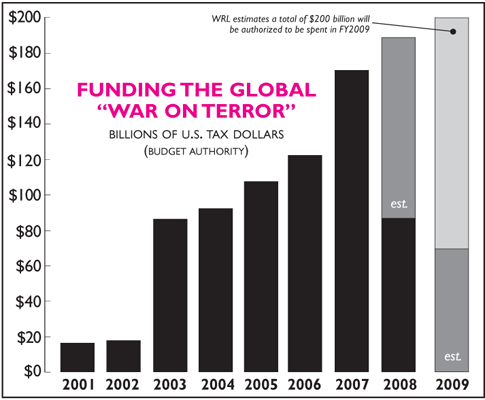
Cost
of the Iraq and Afghanistan Wars (billions
of dollars)
source:
For 2001 to 2008 from Center for Arms Control and Non-Proliferation, armscontrolcenter.org;
for 2009, the Budget includes $70 billion in “allowances†for
GWOT; WRL estimates an additional $130 billion will be authorized for spending
in 2009 and subsequent years, making the total authorized $200 billion.
This graph shows Budget Authority, while the pie on the front is Outlays.
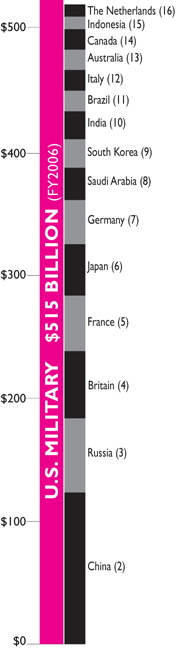
U.S.
Military Spending
vs. The World
U.S. military spending – Dept.
of Defense plus nuclear weapons (in $billions) – is equal to the
military spending of the next 15 countries combined.
These numbers show
military expenditures for each country. Some say that U.S. military spending
will naturally be higher because it has the highest Gross Domestic Product
(GDP) of any country. The United States accounts for 47 percent
of the world’s total military spending, however the U.S.’s share
of the world's GDP is about 21 percent. Also note
that of the top 15 countries shown, at least 12 are considered allies of
the U.S. The U.S. outspends Iran and North Korea by a ratio of 72 to one.


WTCD User Comments
11 years 4 hours ago
11 years 13 weeks ago
11 years 29 weeks ago
12 years 1 week ago
12 years 1 week ago
12 years 3 weeks ago
12 years 10 weeks ago
12 years 10 weeks ago
12 years 10 weeks ago
12 years 10 weeks ago